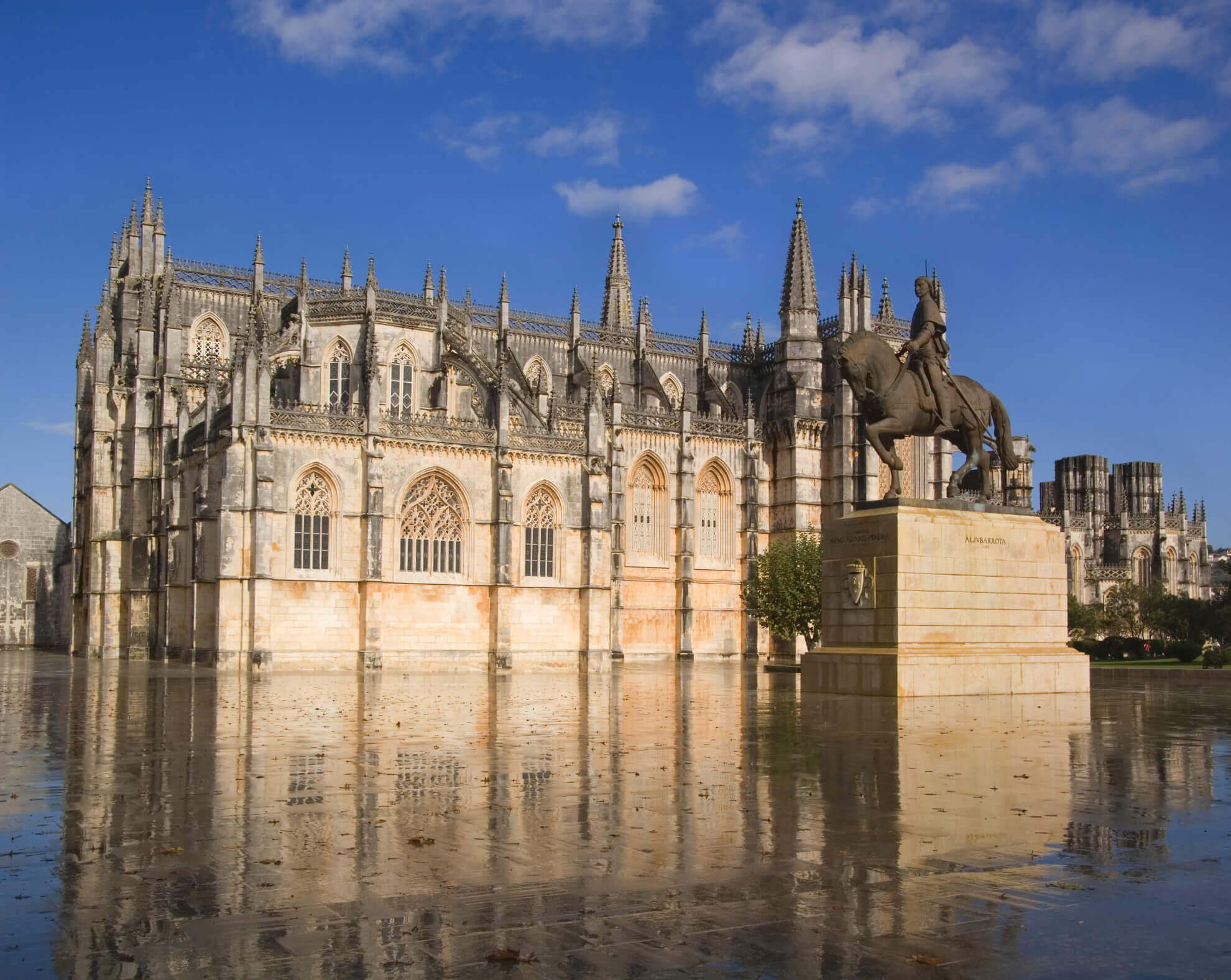
It took 185 years to erect the most magnificent monument of the Portuguese Flamboyant Gothic style, and the genius of masters such as Afonso Domingues, who most likely oversaw the works from 1387 to 1402, Huguet, who worked at Batalha from 1402 to 1438 and was the creator of the Portal da Glória and its 78 figures, Martim Vasques, who took charge of the works from 1438 to 1448, and Fernão D’Évora – who oversaw the building site from 1448 to 1477, Mateus Fernandes, who from 1490 to 1515 devoted himself to the Monastery of Santa Maria da Vitória, and João de Castilho, who designed the Renaissance gallery of the Imperfect Chapels in 1533.
The history of this Dominican Convent began on 14 August 1385, right on the battlefield: King João I had just been proclaimed king, and the future of the House of Avis and the sovereignty of Portugal depended on this victory over the Castilians.
The king vowed to build a monument in honour of the Virgin Mary if he emerged victorious from what came to be known as the Battle of Aljubarrota. The Portuguese defeated the Castilians and King João I kept his promise. Santa Maria da Vitória is the name of the monastery that was built near the site where the battle took place.
Work began in 1386 and continued until 1517. The entire 15th century was dominated by this immense building, which is predominantly Gothic in style and where the first examples of the Manueline style appeared, adding decoration to the Royal Cloister.
From the Church – which rises to a height of 32.5 metres, supported by eight columns on each side – to the two cloisters, passing by the Founder’s Chapel – the Royal Pantheon, designed by Master Huguet, where King João I, Queen Philippa of Lancaster and the Illustrious Generation rest eternally, to the Unfinished Chapels and their distinctly Manueline entrance portico, to the Chapter House and its star-vaulted ceiling, also the work of the highly talented Master Huguet, a room where, every day, the Changing of the Guard takes place daily by the Tomb of the Unknown Soldier, which has stood here since 9 April 1921, to the timeless beauty of the 1514 stained-glass windows in the High Chapel and Chapter House.
Also noteworthy are the dormitory, the dining hall and the kitchen.
We are invited to get lost in the vastness of this sumptuous monument, a World Heritage Site since 1983, which takes us from the Flamboyant Gothic style through the Manueline and Renaissance periods.
Opening hours
From October 16th to March 31st
09:00 - 18:00 (last entry at 17:30)
April 1st to October 15th
09:00 - 18:30 (last entry at 18:00)
Closes on January 1st, Easter Sunday, May 1st and December 25th.